.svg)
In the Tokenized Asset Coalition's 2024 Outlook, Anthony Bassili shared his perspective on how institutional tokenization will evolve.


Tokenization is a vital use case for traditional financial institutions and we expect it to be a major part of the next crypto market cycle, as it is critical for updating the financial system.
This primarily involves automating workflows via smart contracts and eliminating certain intermediaries that are no longer needed in the asset issuance, trading, and record keeping process. Tokens are the next financial “share class” and allowing them to operate on global, permissionless, public ledgers will be paramount to their success. Benefits of utilizing a tokenized share class are as nuanced as they are many, but we expect the validation to become louder as more market participants integrate the tech stack and begin using tokenized assets in their daily workflows. For example, the current high yield environment makes the capital efficiency offered by tokenization much more relevant than it was even two years ago. That is, for institutions, tying up capital for even a few days in higher interest rate environments is much costlier than doing so in lower rate environments. We expect tokenization will dramatically change the spectrum of liquidity, composability, and cost of managing risk across traditional assets.
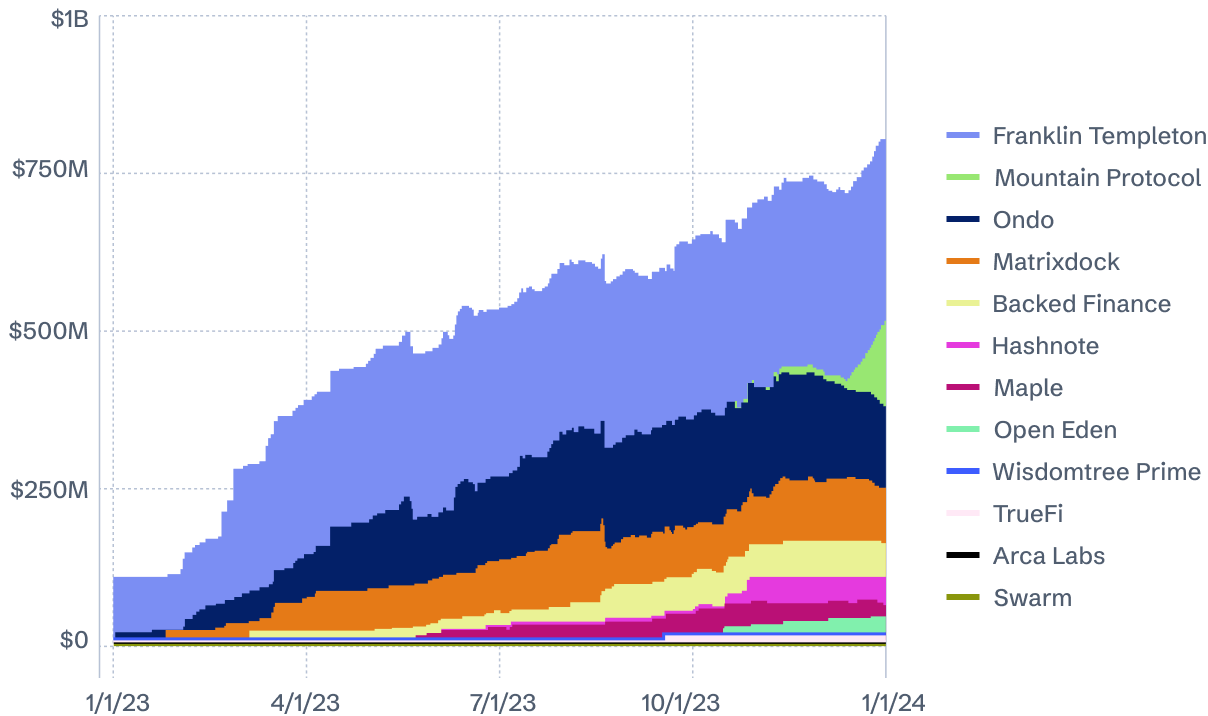
Over the course of 2023, we witnessed dozens of new entrants on public permissionless networks begin to offer access to tokenized US Treasury exposure directly onchain. Total assets held in US Treasury-like exposure onchain has increased 7x to north of US$845M as digitally native users have sought to gain exposure to yields that have no connection to traditional crypto yield sources. Importantly, we have also seen a dramatic rise in the number of new companies building new primitives in the RWA space.
In 2024, we expect to see tokenization expand to other market instruments including equities, private funds, insurance, and carbon credits, given the client demand for higher yielding products and the need for diversified sources of return.
Tokenized US Treasuries on public networks have increased +7x over 2023
Over time, we believe that even more business and financial sectors will incorporate aspects of tokenization, though regulatory ambiguity and the complexities of managing different jurisdictions continue to pose significant challenges for market participants – alongside the integration of new technologies into legacy processes. These challenges have kept most of the largest regulated institutional players on the sidelines or to rely on private blockchains. While private blockchains may continue to grow alongside public permissionless chains, this can potentially fragment liquidity due to interoperability hurdles, which would make it harder to realize the full benefits of tokenization for a sound and robust financial system.
An important theme to watch around tokenization is the regulatory progress being made in jurisdictions like Singapore, the EU, and the UK. The Monetary Authority of Singapore has sponsored “Project Guardian” which has produced dozens of proof-of-concept tokenized projects on public and private blockchains from tier 1 global financial institutions. The EU DLT Pilot regime has developed a framework for enabling multilateral trading facilities to utilize a blockchain for both trade execution and settlement, rather than through a Central Securities Depository. The UK has also launched a pilot regime seeking an even more advanced framework for issuing tokenized assets on public networks. We are encouraged by the progress and forward thinking by our International regulators and certainly expect to see more friendly competition as jurisdictions position themselves on the chess board.
Tokenization is ready to move past “proof-of-concepts” and into commercialization. What’s at stake are billions of dollars of fees saved, fees earned, more transparency into the financial system, democratization of investment options to many who have never had access, and possibly most important, accountability for the institutions and regulators that oversee them.
The content of this blog post was originally published in the Tokenized Asset Coalition's State of Asset Tokenization: 2024 Outlook. To access the full report, click here.
Disclaimer: The content provided in this blog post is for informational purposes only and does not constitute investment advice. The author and this platform expressly disclaim any responsibility for decisions or actions taken based on the information presented. Past performance is not indicative of future results. All investments carry risks, including the loss of principal. No content herein should be interpreted as an endorsement of any particular investment or strategy. Opinions expressed are current as of the date of this publication and are subject to change. The author and platform are not liable for any direct or indirect losses related to the use of the information provided. Always consult with a licensed financial advisor or professional before making any investment decisions and perform your own due diligence.